Fergus De Burca /James Francis Burke
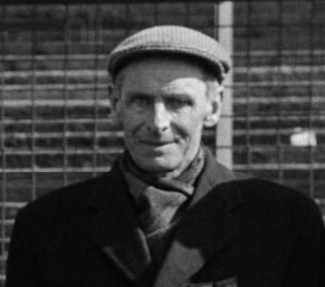
8th April, 1895 – 28th December, 1987
James Francis Burke was an Irish Hurler and Gaelic Footballer, an Irish Revolutionist and School Teacher at St Enda’s Secondary School Rathfarnham and Ardscoil Éanna Secondary School Crumlin.. He played on the senior teams for Dublin’s GAA between 1917 – 1927.
Early Years:
Born in Carbury, Co Kildare in the village of Coonagh in the Barony of Carbury, near Robertstown in North Kildare on 8th April, 1895. He was the youngest of five children born to Henry J. Burke and Marie Kelly of Coonagh, Carbury. His father was American by birth and his mother was born in Co Tipperary. His father was a farmer and employed a farm hand and a housemaid. His father’s sister, five years his junior also resided with them.

Birth Registration of James Francis Burke 1895
His four brothers were all students. Feargus attended St Enda’s School in Rathfarnham, Dublin in 1909. However, Scoil Enda was only formed in 1908 at Cullenswood in Ranelagh so it was very unlikely that his brothers attended Scoil Enda.
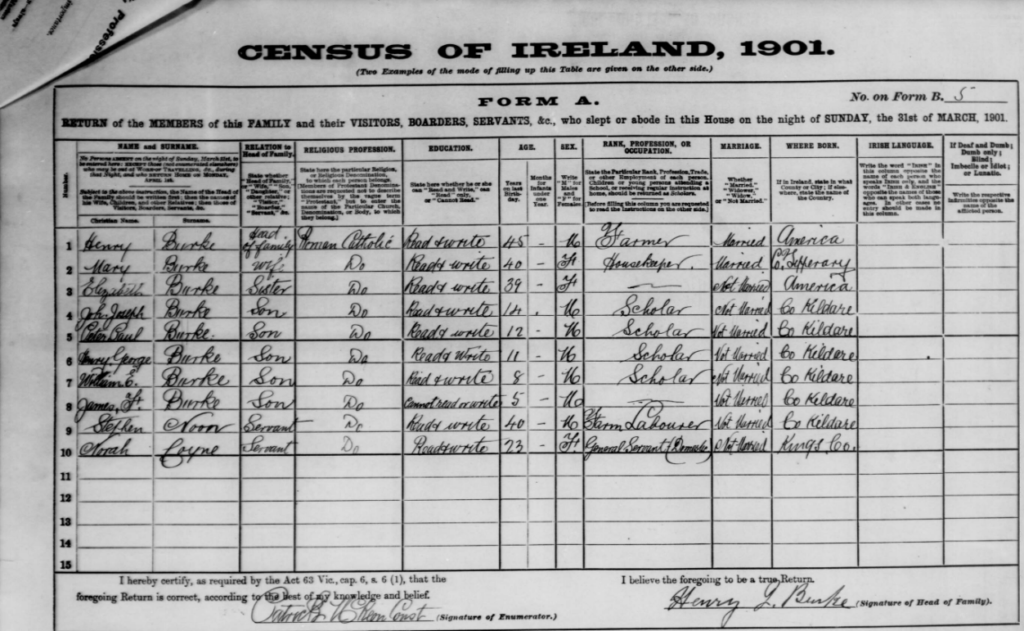
1901 Census of Ireland / Burke Family, Coonagh, Co Kildare.
1911 Census:
Feargus de Búrca was registered as a student at St Enda’s Secondary School on the 1911 Census of Ireland.
Irish Patriotism:
He was influenced by Padraig Pearse and Con Colbert who introduced him to the Irish Republican Brotherhood. He was involved in manufacturing ammunition at St Enda’s in preparation for a rebellion. He graduated from University College Dublin in 1915. Burke was a founder member of the Irish Volunteers in 1913 and was a member of E Company, 4th Battalion, Dublin Brigade. He was one of the pupils at St. Enda’s, Rathfarnham, who acted as a stewards when the Volunteers were formed in 1913.
He was a member of “E” Company, 4th Battalion, Dublin Brigade, who left Rathfarnham on Easter Monday under the command of Lieut. Michael Boland. They marched to Liberty Hall, and from there to the GPO.
He was a sniper from the roof when the Rebellion commenced. He later moving to the ground floor windows of the GPO. Following the evacuation, he was held the barricade in Moore Street, and later at Sackville Lane.
Post 1916 Easter Rising:
Following the Rising he was imprisoned in Stafford and Frongoch and released back to Ireland in December 1916. Upon his release he took up a post as a teacher in St Enda’s School in Rathfarnham, Dublin. He was involved in the War of Independence and was detained on several occasions at Dublin Castle, The Curragh Military, and Arbour Hill Prison.
Gaelic Football Player:
De Burca won several hurling and football medals during his time at University College Dublin. He won his first All Ireland medal in 1914, a second in 1916 and a senior All Ireland medal in 1917. Burke played in nine all-Ireland senior finals with Dublin. He also won All Ireland medals for hurling (1917-1920). He played alongside Harry Boland on the Dublin team in 1918. He won a further three All Ireland football medals (1921-1923).
Bloody Sunday in Croke Park:
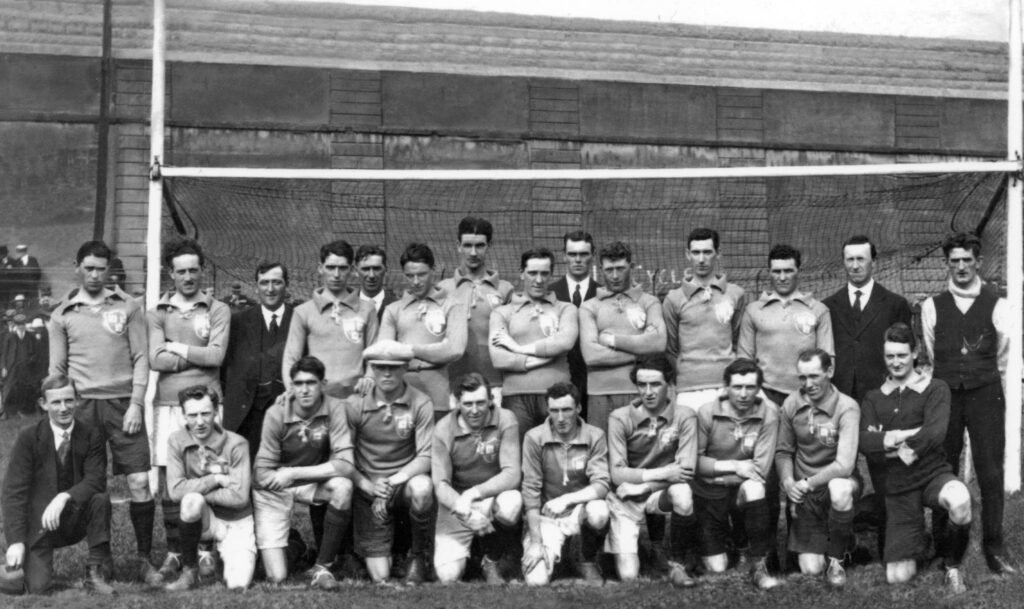
Croke Park – Bloody Sunday 1920
De Burca was a member of the Dublin Team playing Tipperary on Blood Sunday. He was marking Michael Hogan (Tipperary player) in Croke Park on 21st November, 1920 who was shot by the Black & Tans on Bloody Sunday. Collins’ Twelve Apostles (The Squad) assassinated fourteen English Intelligence Officers earlier that morning in Dublin.
The Twelve Apostles and Michael Collins:
De Burca was rumoured to have participated in the orchestration but there is no record of this. His feelings towards Collins changed following the signing of the Anglo-Irish Treaty in London on 21st November, 1921.
Marriage and Family Life:
Angela Curran from Dungarvan, Co Waterford, worked in Stafford, England with a group of Irish girls who were teaching within the vicinity of the prison, The group of girls frequently visited Irish men interned in Stafford Jail following the Easter Rising.
Feargus de Búrca married Angela Curran, a spinster and a teacher, in Dungarvan, Co Waterford on August 22nd, 1923 in Church of Dungarvan, County Waterford. Feargus’ father, Henry J Burke was still listed as a Farmer. Angela’s father was listed as Patrick Curran, Ex-Harbour Master of Dungarvan Harbour. The witnesses were William Edmund Burke, brother of Feargus, and Helen F. Curran, sister of Angela.
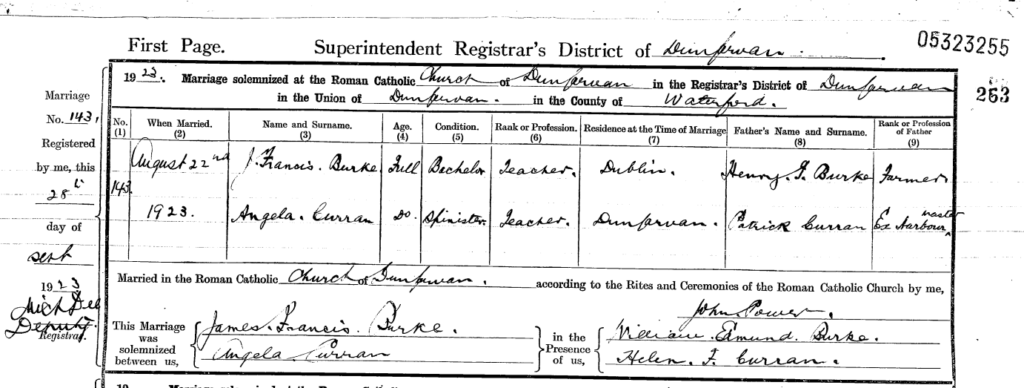
The couple had three children, Máire Damhnaidh de Búrca born on 15th May, 1924, Éanna de Búrca born circa 1930 and another girl.
1926 First Census of the Irish Free State:
Feargus de Búrca was listed with his wife, Aingeala, and their one year old daughter, Máire Damhnaidh living at St Enda’s College, in the Townsland of Haroldsgrange, in the D.E.D of Whitechurch, Rathfarnham, Co Dublin at the time of the 1926 First Census of the Irish Free State. His record was “as Gaeilge”, written in Irish. The family were all Catholics, he was registered as the Head of the Family, both he and his wife were married “Posta”. He was School Principal and his employer was Mrs Pearse, St Enda’s School, Rathfarnham. His wife was a Housekeeper born in Dungarvan, Co Waterford. Their daughter, Máire Damhnaidh was born in Dublin on May, 24th 1924.
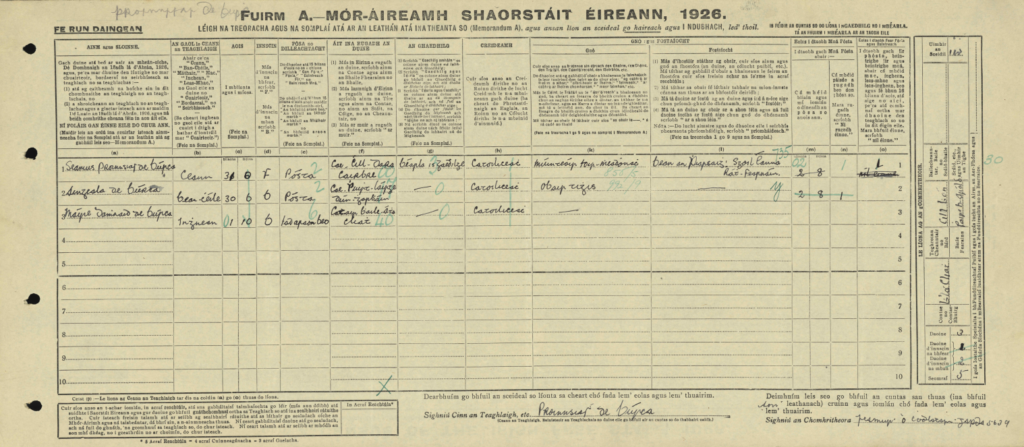
1926 Census of the Free State of Ireland – Form A
Form B1 – House and Building Return lists inhabitants of St Enda’s College in the Townsland of Harold’s Grange, in the District Electoral Division of Whitechurch, Rathfarnham. The head of the household is Mrs Pearse.
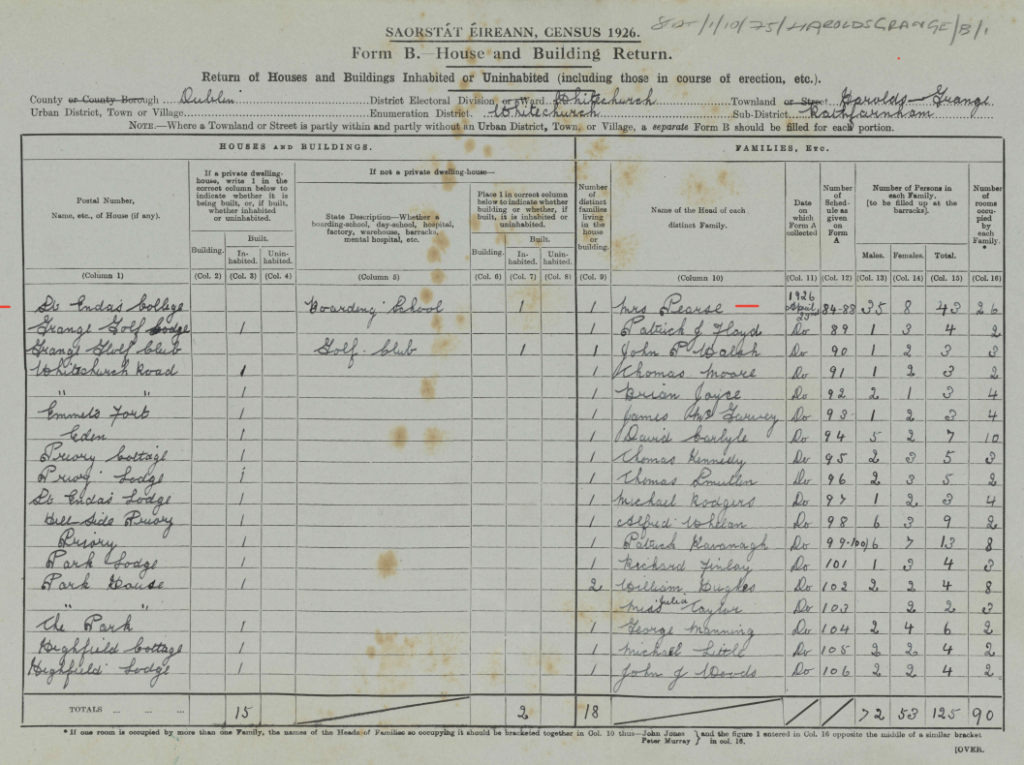
Form B – House and Building Return
Form B2, a continuation of the House and Building Return lists Frank Burke living in St Enda’s House which has five rooms with two females.
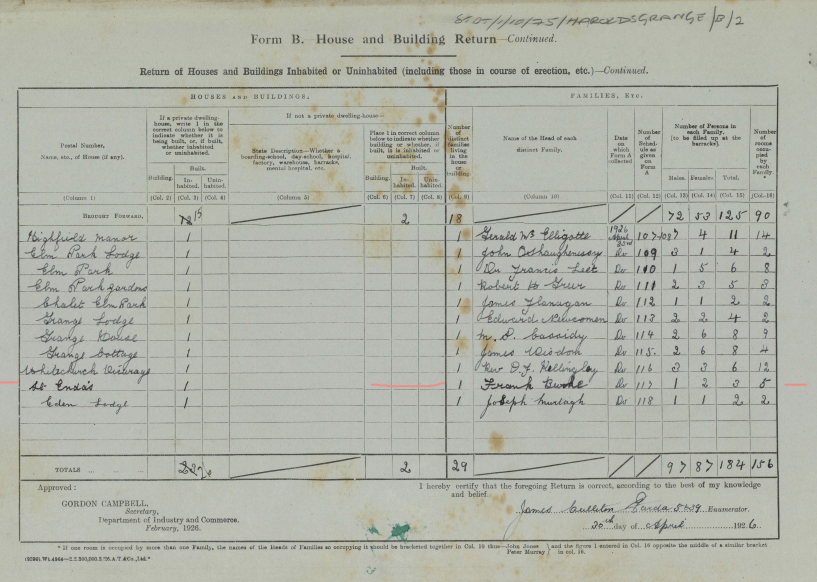
Form B2 House and Building Returns Form for St Enda’s College
Teaching Roles:
De Búrca taught at St Enda’s School in Rathfarnham from January 1917 and became Headmaster of the school in 1923. He became Honorary Secretary of the Pearse Memorial Committee to raise money to buy Hermitage House which they successfully purchased in 1920. Padraic Pearse had commenced his fundraising campaign of Scoil Éanna ( St Enda’s School) in 1909. He had set up the school in 1908 with his brother Willie. By 1910 the school had grown in size and students were successful in achieving educational grades but was haemorrhaging into bankruptcy. Padraic Pearse travelled to America to campaign for funds from Irish Fenians. It was there he was radicalised towards a United Ireland. He became distracted from fundraising and returned with a different goal towards a United Ireland. Feargus De Búrca became the administrative backbone to seek funds for the school, whilst Margaret Pearse (sister of Padraic) and his mother, Mrs. Pearse travelled to America to push for funding for the school
Following the closure of St Enda’s School in 1935, he taught at the Garda Depot in the Phoenix Park and at Rathmines V.E.C until 1939. De Burca also taught for a period of time in Árdscoil Éanna School, Crumlin. He joined the Civil Service until his retirement.
Bureau of Military History 1952:
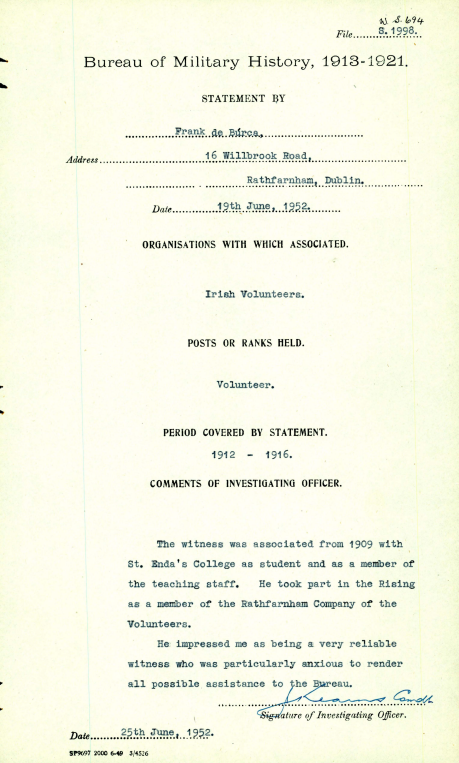
On 19th June, 1952 Feargus De Búrca gave a witness statement (BMH694) to the Bureau of Military History relating to 1913 – 1923 but specifically relating to the Irish Volunteers between 1912 – 1916 and the Easter Rising. His statement was investigated by Commdt J Kearns who quoted that he “was impressed by this very reliable witness”. There was no pension file available when researched in 2026.
Death of Feargus De Búrca:
He died in the Meath Hospital in 1987 and was buried in Cruagh Cemetery, Carbury, Co Kildare.
References:
- Birth Registration of James Francis Burke 1895; Irish Genealogy Birth Registration
- James F. Burke – National Archives Census of Ireland 1901
- Feargus de Búrca – National Archives Census of Ireland 1911
- The Squad and the Intelligence Operations of Michael Collins (Dwyer:2005 Mercier Press)
- Frank Burke Dictionary of Irish Biography link
- Frank Burke and The 1916 Rising Blog by Historian & Author, James Durney
- The Twelve Apostles: Michael Collins, The Squad and Ireland’s Fight For Freedom. (Coogan TP, 2018)
- DE BÚRCA, Feargus (1895–1987); Ainm.ie
- The History of Ireland; St Enda’s School
- Life at the Hermitage in the late Georgian period: Tour at the Pearse Museum OPW Heritage
- Black & Tans; RTE Century Ireland Archives
- 1926 First Census of the Irish Free State
- Form B1 – House and Building Returns Form (1926)
- Form B2 – House and Building Returns Form (1926)
- The Bureau of Military History 1913 – 1921
- Feargus De Búrca Witness Statement: Bureau of Military History 1952 researched by Historian Liz Gillis (July 2026)
- The Meath Hospital
- Find a Grave – Feargus De Búrca, Aingeala De Búrca, Daimhnaidh De Búrca
- Éanna De Búrca; RIP.ie
Research was undertaken for this article by Irish Historian and Author, Liz Gillis, originally from the Liberties, Dublin who specialises in the Irish Revolution. She is the author of six books including, ‘The Fall of Dublin’, ‘Revolution in Dublin’, ‘Women of the Irish Revolution’, ‘The Hales Brothers and the Irish Revolution’ and ‘May 25: The Burning of the Custom House 1921’. Liz researched the Irish Military Archives and Pension Records on Feargus De Búrca.
Further research was undertaken by Patricia Ryan, Researcher in Public Affairs and Genealogist in Irish Family History who is a member of Historical Drimnagh, a community heritage group supported by Dynamic Drimnagh and Dublin City Council.