
Anne Devlin Bridge

Anne Devlin Luas Bridge is situated between Suir Bridge (adjacent to the First Lock of the Grand Canal) and Griffith Bridge (1793 Turnpike of the Grand Canal). It connects Davitt Road to Rialto via the Linear Park. The bridge was opened in 2004 to facilitate the crossing of the Red Line Luas from Suir Road Luas Stop to Rialto Linear Park.
Ann Devlin – The Patriot
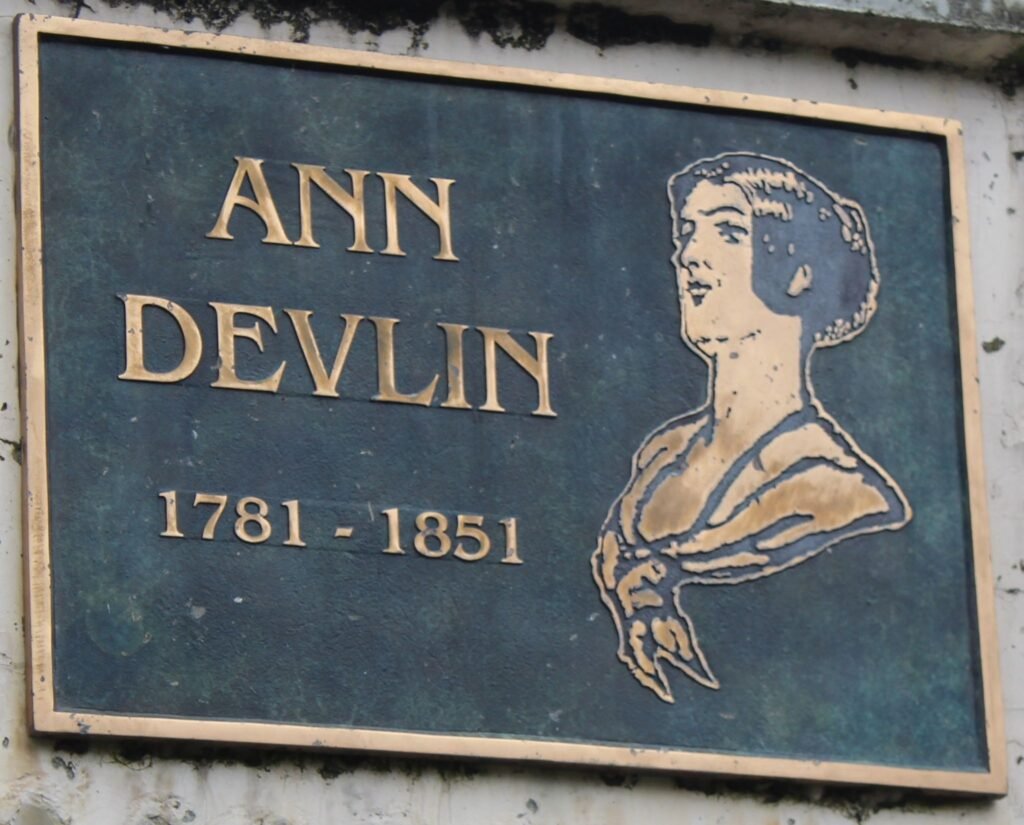
1780 – 1851
Birthplace:
Anne Devlin was born at Cronberg, near Aughrim, Co Wicklow in 1780. She was the second eldest of seven children. The family moved to Rathdrum, Co Wicklow, when she was a young child. The Devlin family were nationalists at heart and inspired by the ideology of the United Irishmen. Her father Bryan Devlin, a successful tenant farmer, was known to be quite outspoken about the treatment of Catholics during an era which was rather treacherous for catholics and nationalists.
Anne’s first cousin on her mother’s side, was the infamous Wicklow rebel leader, Michael Dwyer who was involved in the 1798 Rebellion. Born in 1771, he was instrumental with his “hit and run” brigade.
Anne was also related to the O’Tooles and the O’Byrnes who attacked the English at every opportunity. Despite their nationalistic views the Devlins raised their family to respect the law and they in turn were respected by all who knew them.
Anne’s Goldenbridge Era:
Anne’s father rented a 30 acre farm from their landlord, Mr Thomas Darby who was a very reasonable man. Mrs Darby’s sister (Miss Leonard) married Lieutenant Heppenstall, (“The Walking Gallows”) in 1797. She sought permission from the Devlins for Anne to work in service at her new home at Goldenbridge, Dublin. However, she returned home after a few months.
The 1798 Rebellion and the United Irishmen:
Following the 1798 Rebellion, Anne’s father, brother, two uncles and two cousins were arrested and held in Wicklow Gaol for a period of time. Hugh O’Byrne did escape but was later recaptured and executed. After over two years in prison her father petitioned for a retrial as no formal charge had been made against him personally. He was unexpectedly acquitted.
Rathfarnham, Dublin:
Following his release from Wicklow Gaol, Anne’s father decided to relinquish the lease on his farm and moved to Butterfield Lane, Rathfarnham near Dublin where he founded a dairy business and kept horses for hire to the local gentry.
In 1803, a “Mr. Ellis”,(alias for Robert Emmet) moved to Butterfield Lane near to the Devlins where there was a regular flow of visitors to his home. One of whom was Myles Byrne, a prominent leader of the 1798 Rising with Fr. John Murphy. Byrne travelled to France and subsequently died in Paris.
Devlin befriended Emmet and provided him with a cow, a horse and a cart to portray his wealth. “Mr Ellis” now required the services of a housekeeper. Anne Devlin, became his housekeeper at The Hermitage in Butterfield Lane and assumed the surname Emmet. However, she was his confidante at meetings and carried messages to/from rebels.
Emmet’s true love was Sarah Curran, daughter of John Phillpot Curran, an Irish lawyer of civil liberty who defended Wolf Tone, a politician and orator. The Currans lived at The Priory on Butterfield Lane which was adjacent to The Hermitage. Anne Devlin carried messages to/from the lovers. Following Emmet’s failed rebellion in 1803, Curran disowned his daughter. She died in 1808 of TB and her father refused to allow her to be buried in the grounds of The Priory.
The Rebellion of 1803
On 23rd July 1803, Emmet’s troops assembled and marched towards Dublin Castle. The Lord Chief Justice, Lord Kilwarden’s carriage was attacked in Thomas Street by an unruly mob, leading to his death and that of his nephew. The mob dispersed and Emmet fled to the Wicklow mountains.
Arrests and Imprisonment:
On 26th July, 1803, Anne Devlin and her sister were questioned and almost killed by Yeoman who entered “Mr Ellis’ house” in Butterfield Avenue. They escaped to their cousin’s home (Michael Dwyer’s sister) in Newmarket in the Coombe but were arrested some days later and taken to the Coombe Guardhouse. Upon their release, they returned to their family home in Rathfarnham where the entire family was arrested. Despite her youngest brother having smallpox, he was arrested and later died from neglect in Kilmainham Jail. Anne was identified by staff at White Bull Inn, Thomas Street and was questioned by Major Sirr. She refused to talk despite being offered £500. She was charged with treason and transferred to Kilmainham Jail as Prisoner 98.
“You may murder me, you villains; but not one word about him will you ever get from me” – Anne Devlin
Robert Emmet was arrested at a house in Palmer’s House, Harold’s Cross on 29th August, 1803 under the assumed name of Hewitt. A plaque has been erected upon the wall of 23 Harold’s Cross.
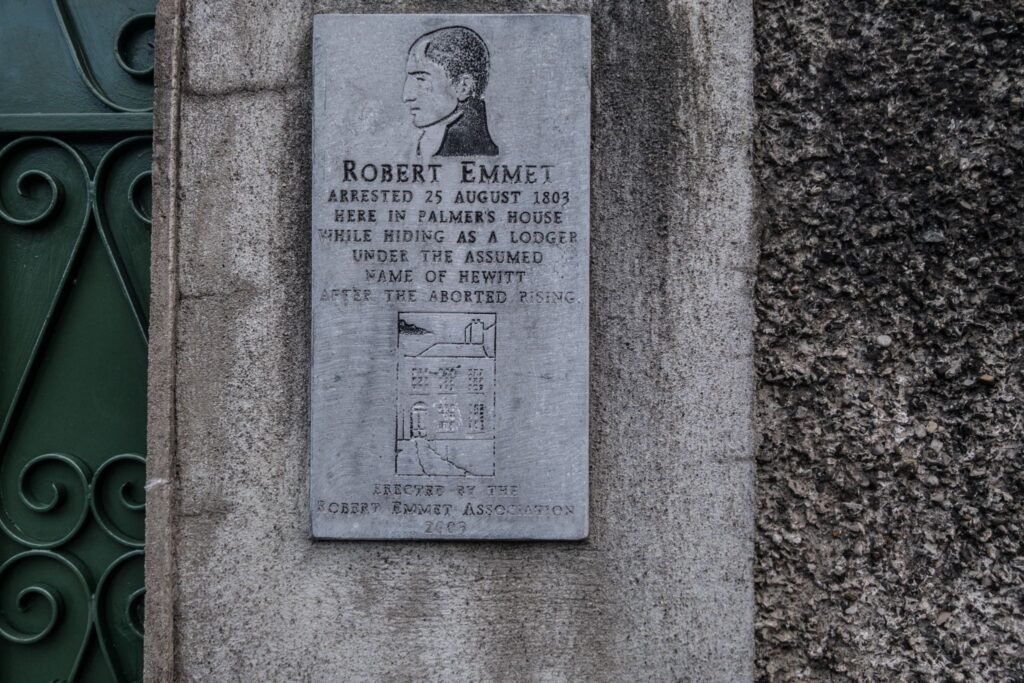
He had a brief encounter with Anne Devlin in Kilmainham Jail, where they were both incarcerated. He encouraged her to save herself and give them whatever information they required but she refused. He was publicly hanged in Thomas Street on 20th September, 1803 following a trial at Green Street Courthouse.
“Let no man dare, when I am dead, to charge me with dishonour; let no man attaint my memory, by believing that I could have engaged in any cause but that of my country’s liberty and independence; or that I could have become the pliant minion of power, in the oppression and misery of my country.” – Robert Emmet’s Speech from the dock in Green Street Courthouse
Ironically, Mander’s Brewery in the Liberties, went into decline following the use of its barrels to prop up the platform where the scaffold was created to execute Robert Emmet, opposite St Catherine’s Church.
Anne was forced to witness the execution before being returned to Kilmainham Jail where she was tortured by Dr Edward Trevor (The Devil’s Partner/The Beast of Kilmainham) with every imaginable device available. The Habeas Corpus Act 1778 She failed to give the names of Emmet’s accomplices and saved over fifty men from death. Following a change in government Anne was transferred to Dublin Castle where hidden by Trevor in a closet. Her imprisonment violated the re-enactment of the Habeas Corpus Act 1804, as she was never brought to trial before a judge and jury. Her health had deteriorated significantly and she was released in 1806 at the behest of the chief jailer’s wife.
She found employment with a friend of the Emmet family, Mrs Elizabeth Hammond at 84 Sir John Rogerson Quay for a period of four years until her death in 1810.
Marriage And The Campbell Family:
She married a man called William Campbell at St Catherine’s Church, Meath Street in April 181. Anne had three children who were all baptised ; Catherine in 1812, William in 1816 and Mary Anne in 1822 who moved to America in the 1840’s. The family lived at John’s Lane West, off Thomas Street until 1845.
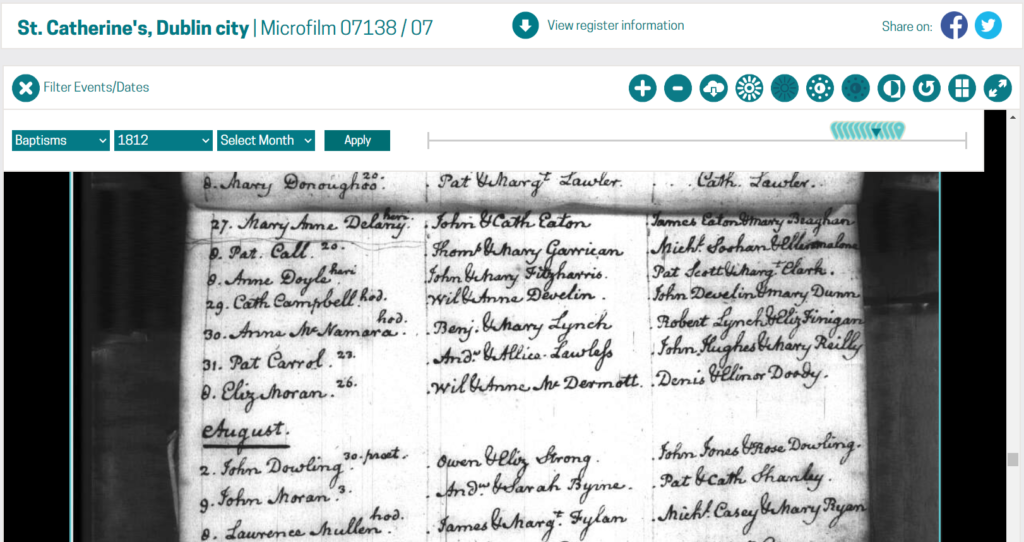
Catherine Campbell baptised at St Catherine’s RC Church, Meath Street in 1812
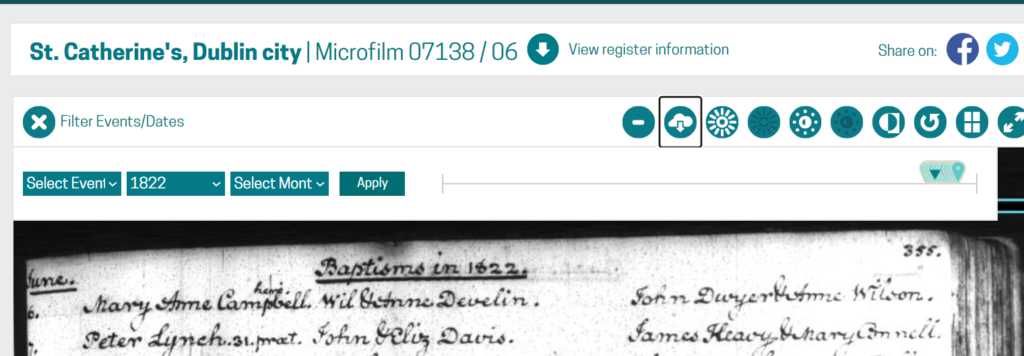
Mary Anne Campbell Baptised at St Catherine’s RC Church in 1822
St Patrick’s Hospital’s archives show that Robert Emmet’s father was a doctor at the hospital for the insane for a period of thirty years. It also shows records of Anne Devlin working as a laundress at the hospital from 1825 – the late 1830’s. Patrick and Sarah Campbell were Master and Matron of the hospital during that era and retired in the late 1830’s. It may well be the case that Anne Devlin lost her job upon their retirement.
When Ann’s husband died in 1845 she was left in poverty until her death on 16th September, 1851. Visually impaired and unable to work, she spent her last few years living in deprivation at 2 Elbow Lane near The Coombe in Dublin. She was buried in an unmarked grave in Glasnevin Cemetery. Anne Devlin was the first female political prisoner in Ireland.
Irish Historian Dr. Richard Robert Madden sought Mrs Campbell out before her death to assist him with the research of his book on Robert Emmet. Upon hearing of her death, he arranged for her re-interment to a more prestigious section of Glasnevin Cemetery (the Republican Plot) where a tombstone was erected to commemorate her as one of Ireland’s unsung heroes.
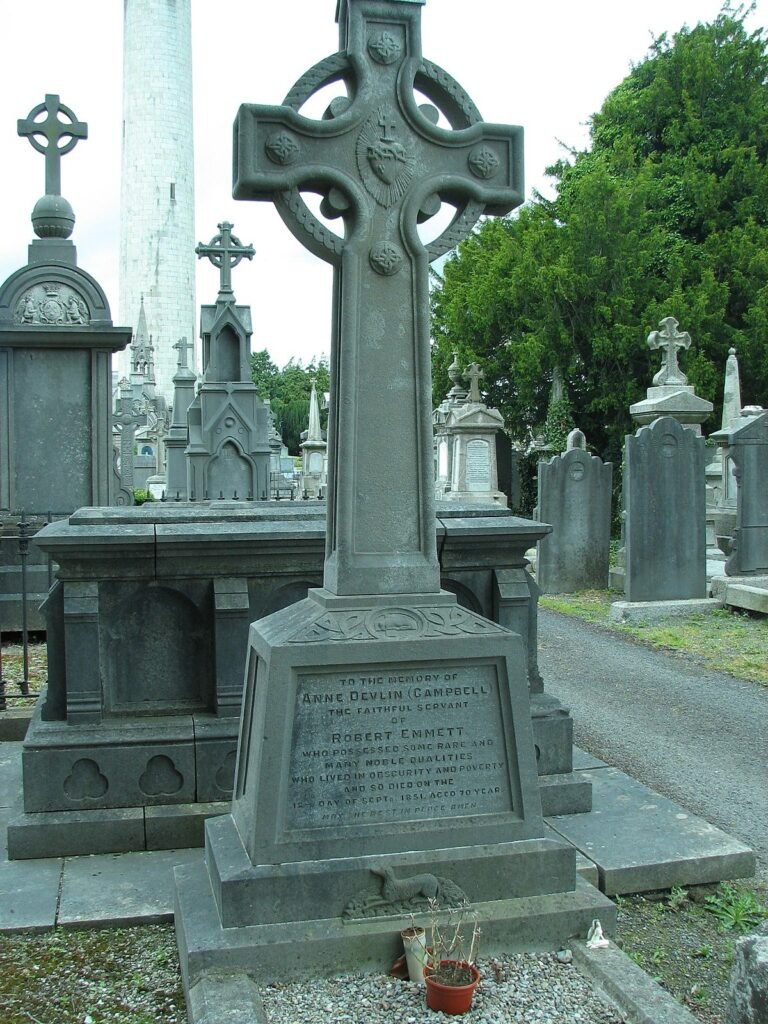
The inscription reads;
To the memory of Anne Devlin (Campbell), faithful servant of Robert Emmet, who possessed some rare and noble qualities: who lived in obscurity and poverty, and so died, the 18th day of September,1851, aged 70 years.
References:
- Growing up in the Liberties – Facebook page
- https://www.askaboutireland.ie/learning-zone/primary-students/looking-at-places/wicklow/anne-devlin/
- Glasnevin Trust https://www.dctrust.ie/genealogy/home.html
- Kilmainham Tales
- The Wild Geese: Remembering Anne Devlin; Micheal O’Doibhlín, 24th September, 2014.
- Anne Devlin – bravest of the brave
- Townlands
- The Court Services of Ireland – Robert Emmet
- Comeheretome: From Grandeur to Ruin; The Story of Sarah Curran’s Home in Rathfarnham – Sam McGrath 27th December, 2012
- United Diocese of Cork, Cloyne and Ross: Sarah Curran and the Robert Emmet Link
- Anne Devlin; Irish Independent 28th September 2006
- Anne Devlin’s Society Belfast Facebook Page
- The Priory Ruins HERMITAGE Facebook page: January 27, 2022.
- The Anne Devlin Memorial Committee: Dublin South County Council
- The Robert Emmet Association, Dublin, Ireland
- Choosing The Green: Irish Women, Politics and History; Anne Devlin, Ireland’s Almost Entirely Ignored Hero, 27th September 2014.
Research for this article has been undertaken by Irish Historian and Author, Cathy Scuffil, who has an MA in Local History from Maynooth University. She was the Historian in Residence for Dublin’s South Central area which includes the historic Liberties and some of the city’s oldest suburbs. Cathy has written a number of local history books in all volumes of “History on Your Doorstep” Volumes 1 to 8. She also published an abridged version of her MA thesis was awarded the Old Dublin Society’s silver medal in 2018. She lectures on the Lord Mayor’s Certificate, NUI Maynooth Local History Courses, at Dublin City Council Libraries and Dublin South County Council Libraries for local history courses.
Additional research was carried out by Patricia Ryan, Public Affairs Researcher and Genealogist in Irish Family Law, who is a member of Historical Drimnagh, a community heritage group supported by Dynamic Drimnagh and Dublin City Council.