Goldenbridge
Goldenbridge is a village in the Parish of St James, two miles west of Dublin City on the road to Naas. It is adjacent to the Second Lock of the Grand Canal. The village had an extensive industrial network of mill-races and ponds developed on the River Camac extending south to the mill at Drimnagh Castle, Mount Shannon Mills and Harcourt Mills to the east. Proprietors of the Goldenbridge paper mills and the Hibernian woollen mills built housing nearby in order to draw in the skilled workers they needed.
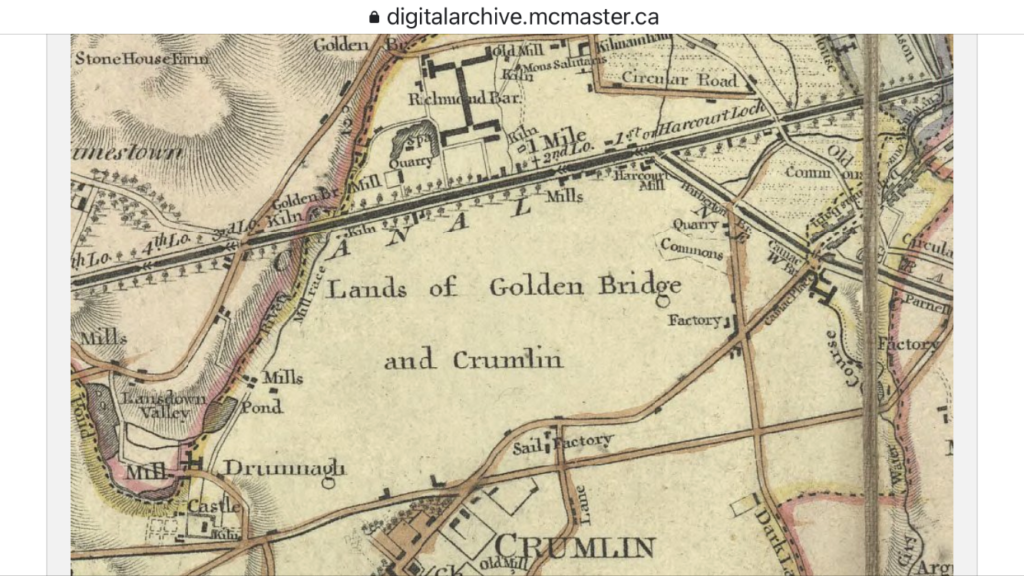
It consisted of Richmond Barracks built in 1810 on 14 acres of land, in response to a threat of a Napoleonic invasion. All military personnel were stationed there prior to the Crimean War, Boer War and The Great War. It had two openings to the north and south of the barracks that housed 76 officers and 1,600 non-commissioned officers, an infirmary and 25 horses fed by corn from Mountshannon Mill.
The chalybeate spring in the village was known as the Waterloo Spa which was perhaps associated with the Napoleonic War. It was described as a sulphuretted hydrogen gas and carbon acid with magnesia benefits for digestive complaints.
In 1828, Daniel O’Connell, the Liberator and advocator of Catholicism funded the opening of Goldenbridge Victorian Garden Cemetery consisting of 2 acres. The neo-classical mortuary chapel with an underground vault was built between 1830-1835. Mass burials took place during the Great Famine (1845-1849) and the cemetery closed due to a cholera epidemic in 1867. The cemetery is now managed by the Dublin Cemeteries Trust and has reopened to the public.
In 1851, the Census Population of Ireland reported that there were 241 houses and 1,167 residents living in Goldenbridge Town. There were 35 houses and 140 residents living in Goldenbridge North and Goldenbridge South.
Following the Easter Rising 1916 the barracks held 3,000 prisoners prior to sentencing. It was handed over to the Irish Free State in 1922 and became St Michael’s Catholic Boys School run by Christian Brothers. In 2016 the building was refurbished to reflect its historical importance. The adjacent Episcopal Chapel became St Michael’s RC Church when the Irish Free State was formed in 1922.