
LT. MICHAEL SWEENEY
IRISH REVOLUTIONIST
18th December,1900 – 20th April,1922
Birth:

Baptism of Michael Sweeney page 1

Baptism record of Michael Sweeney page 2
Michael Sweeney was the second eldest of six children born on 18th December, 1900 to Hugh and Bridget Sweeney. He was born at 3 Emmet Street, Harold’s Cross, however, the family later moved to 5 Harold’s Cross Road, Dublin. He was an engineer/motor mechanic who worked in a garage on Haddington Road in Donnybrook, Dublin.
1901 Census of Ireland:
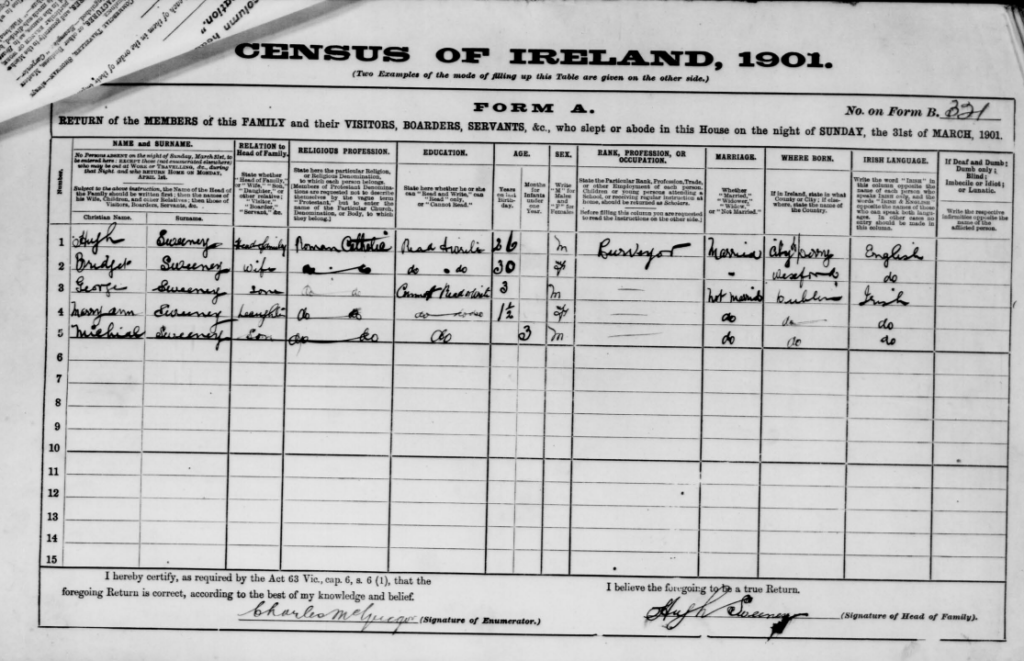
1901 Census of Ireland – 321 Emmet Street, Harold’s Cross.
He was three months old at the time of the 1901 Census of Ireland and the family were living at 321 Emmet Street, Harold’s Cross in the District of Rathmines.
1911 Census of Ireland:
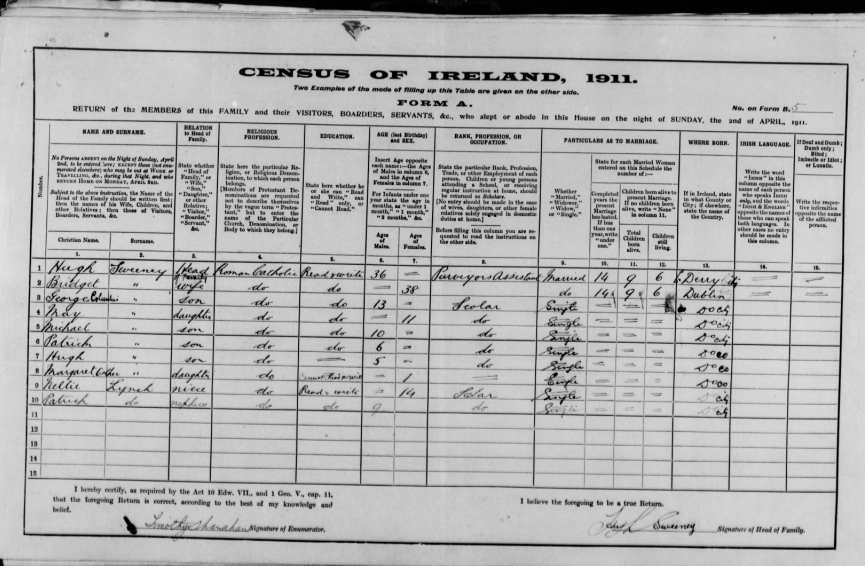
1911 Census of Ireland for 5 Harold’s Cross Road; DED: Rathmines and Rathgar West. Dublin City.
Michael was 10 years old when the 1911 Census of Ireland was completed. He was living with his parents, Hugh and Bridget Sweeney at 5 Harold’s Cross Road, along with his five siblings. His father was a Surveyor’s Assistant and was born in Derry, Northern Ireland.
The 1916 Rising:
Michael Sweeney’s fight for Irish freedom began at a young age; he fought in the South Dublin Union at just 15 and is documented as having carried out direct attacks. He was a member of C and F companies, 4th battalion, Dublin Brigade.
On 5th May 1916 he along with many other revolutionaries were marched to the Dublin Docks by British Forces to be transferred to Wakefield Internment Camp in West Yorkshire, also known as Lofthouse Camp. The camp was built in 1908 and used to intern World War I German and Turkish soldiers in chalets.
Michael Sweeney wasn’t deterred by the executions of 1916 rebels and joined the Irish Volunteer Forces and became Section Commander of the 4th Battalion of the Dublin Brigade and a member of the elite Active Service Unit of the IRA, succeeding Gus Murphy.
War of Independence:
According to notes from the Irish Miliary Archives (page 18), Sweeney may have received a promotion in November 1920.
Attack on Custom House:
On 25th May, 1921 he was one of several men who took part in the attack and burning of Custom House.
Ambush of British Forces at Yeates Pub (now The Halfway House):
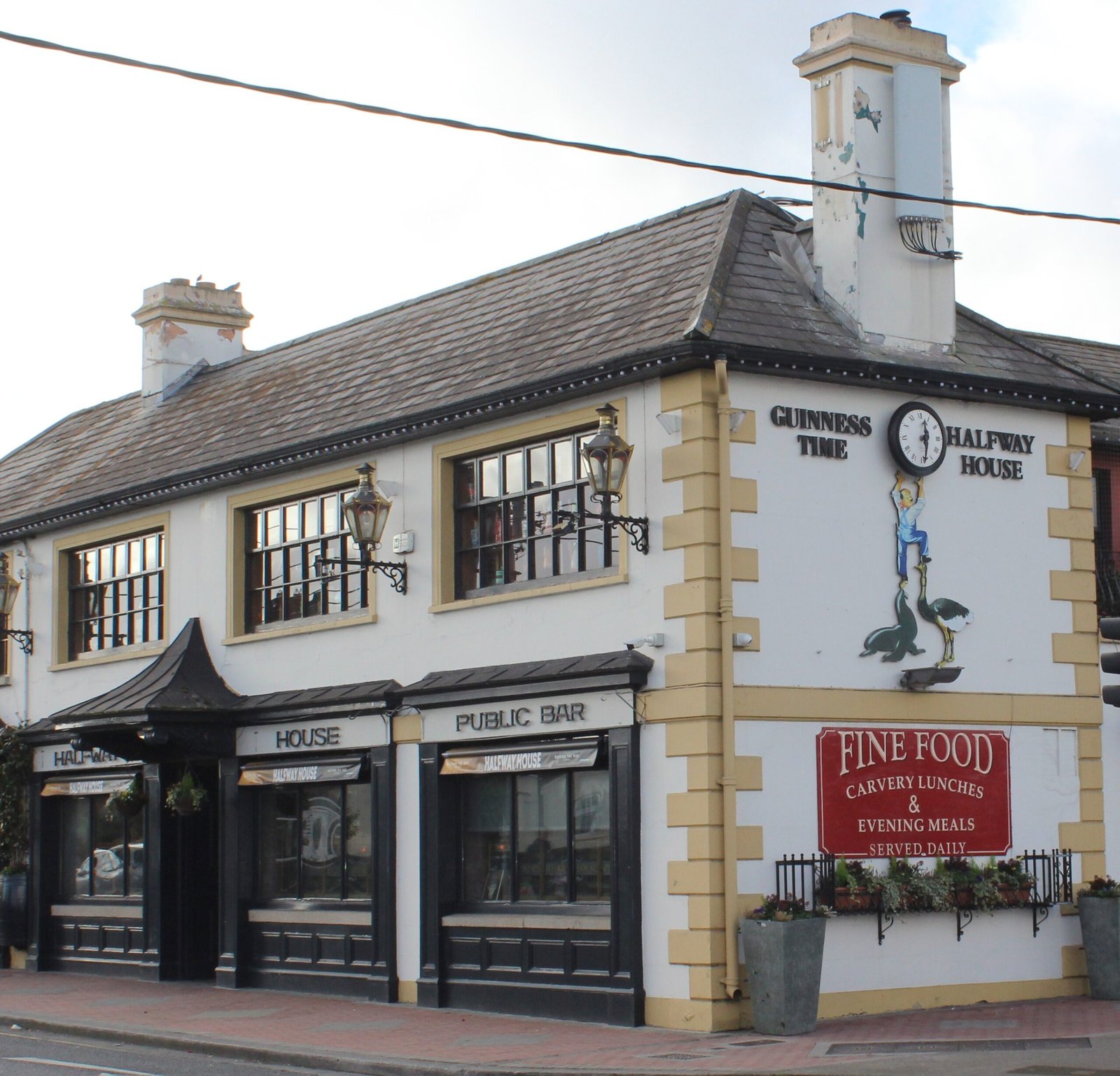
He also led an attack on British Forces at Yeates Public House (now the Halfway House Pub) causing significant casualties. In a reprisal attack British soldiers burnt the pub to the ground the following day. Michael was seriously wounded when a grenade rebounded during the attack. He was taken to Walkinstown House (now the location of a Supervalu, previously Superquinn, and historically linked to Bird Flanagan). Though initially refused help there, passing workers generously offered their bicycles, enabling Michael to be transported to a safe house for medical care. Lieut. Michael Sweeney from Harold’s Cross had been O/C of ASU No. 4 Section until his wounding at Crumlin in 1921 (He was succeeded by Custom House Man Padraig O’Connor).
IRISH CIVIL WAR:
Having taken the Anti-Treaty side of the Irish Free State, he was arrested and held in GHQ Beggar’s Bush where he went on hunger-strike. While under arrest and being conveyed to Mountjoy Prison by GHQ staff, he attempted to escape near Grafton Street but was shot in the head in what is considered controversial circumstances. He was still suffering from the lameness caused by the Yeates Pub (Halfway House) attack. He died the same day in Jervis Street Hospital on Monday April 10th, 1922 just 21 years old.

Death Record of Lt Michael Sweeney
Funeral Procession:
Michael Sweeney’s funeral procession, which began at Mount Argus Church, Mount Jerome, drew crowds lining the streets from Harold’s Cross to O’Connell Street. A notable sign of respect occurred at Leonard’s Corner, near Wellington Barracks (recently occupied by pro-Treaty forces), where the Tricolour was flown at half-mast as the large cortege passed. Furthermore, the GAA AGM, being held at the Gresham on the day of the funeral, was temporarily suspended so that members could honor the memory of the brave 21-year-old rebel.
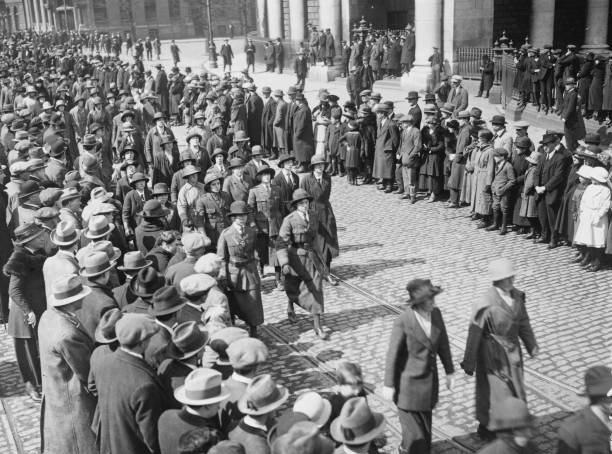
Cumann Na mBán marching in the funeral procession along College Green towards Sackville Street (O’Connell Street) 1922.
Inquest into his Death:
His inquest was attended by the Lord Mayor of Dublin.
Burial:
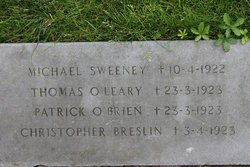
Republican Plot: 132482343 – Glasnevin Cemetery
Michael is interred in the Republican plot in Glasnevin Cemetery, alongside Countess Markiewicz and many other notable figures. Inspired by Pearse’s oration, he had told his mother, Bridget, that he wished to be buried “at the feet of O’Donovan Rossa.”
Military Pension:
In October 1937, Mrs Bridget Sweeney (mother of the late Lt. Michael Sweeney) of 14 Grove Park, Rathmines applied to the Army Pensions Board for a pension (DP6152) (52APB680) (2RB4099).
Padraig O’Connor – BMH 813 – confirmed on page 27 of his witness statement that Sweeney was his Section Commander. He confirmed that Sweeney organised the Ambush on Yeates Pub (now the Halfway House Pub) on May 5th, 1921 and was badly wounded. On page 26 of his statement he confirmed that Sweeney escaped on a bicycle. He also stated on page 29 of his statement, that following Sweeney’s admission to hospital for treatment of his wound, Gus Murphy was promoted to Sergeant.
Patrick Collins – BMH 506 – also confirmed that he met Sweeney at a meeting of an Active Service Meeting. Sweeney became his sweeney Commander in the original 4th Battalion in April 1921. He also confirmed on page 6 of his witness statement, Sweeney’s involvement in the ambush on the British troops at Yeates Pub (now the Halfway House) on May 5th, 1921.
On page 3 of Joseph McGuinness witness statement – BMH 607 – in the Irish Military Archives, he stated that he kept arms in Drimnagh Valley, presumably Lansdowne Valley Park. On page 6 he confirmed that he was a member of Dublin’s Active Service Unit. On page 7 he confirmed that Sweeney was his Sergeant in the 4th Section of the Active Service Unit covering Thomas Street, Inchicore and Dolphin’s Barn. On pages 10 and 11 of his witness statement he confirmed that he was with Sweeney when he executed the main witness against Frank Moran which led to his execution in 1921. Moran had been a member of the Twelve Apostles responsible for assassinating Leonard Wilde, a former British Consul to Spain and Patrick Joseph MacCormack, a World War 1 Veteran and relative of Michael Davitt, at the Gresham Hotel. He denied his involvement in the assassination of Lt. Peter Ashum Ames, an Americal born British Intelligence Officer, outside of 38 Mount Street, Dublin. McGuinness confirmed on pages 15 and 16 of his statement, that Sweeney carried out the ambush on British troops at Yeates Pub on November 5th 1920. He claimed that Sweeney’s grenade backfired on him and he was subsequently wounded. He found him outside Walkinstown House, which was home to one of the Flanagan brothers. Sweeney was refused assistance from the owners but later escaped on a bicycle.
“It was usual for a despatch rider to take despatches on his motor bicycle from the Viceregal Lodge to Dublin Castle, so it was decided to hold him up and relieve him of his despatches. About 2.30 or 3 p.m. on a certain day, three of us took up a position near Rialto Bridge and, as the despatch rider came along, we shouted at him to halt. “It was usual for a despatch rider to take despatches on his motor bicycle from the Viceregal Lodge to Dublin Castle, so it was decided to hold him up and relieve him of his despatches. About 2.30 or 3 p.m. on a certain day, three of us took up a position near Rialto Bridge and, as the despatch rider came along, we shouted at him to halt. This he refused to do and we had no option but to fire on him. He was killed outright; the bicycle was confiscated and likewise the despatches and revolver. The despatches were later sent to headquarters. Michael Sweeney, the Section Commander, rode away on the bicycle and we went our separate ways. A bullet, fired from one of our guns, ricocheted off the wall and struck me in the left hand. We later heard that the despatch rider who was killed that morning was the man who identified the late Frank Moran on Bloody Sunday” – Joseph McGuinness, Evergreen Cottage, New Road, Clondal
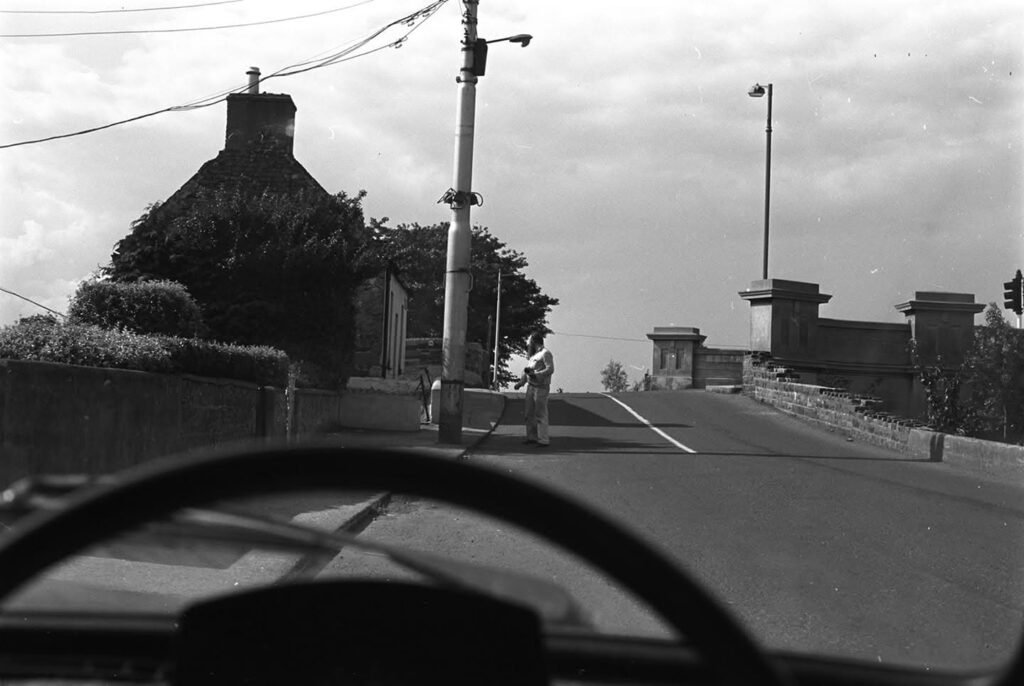
Photo St. James’s Walk Rialto. Rialto Bridge on right, officially Harcourt Bridge after former Viceroy Simon Harcourt. Former lock keepers cottage on left. The bridge was rebuilt in the 1930’s. Photo by Séamas Mac Philib and part of the National Folklore Collection.
Gerald Doyle – BMH 1511 – confirmed on his witness statement that he first met Sweeney at Keogh Barracks (page 11) and George Nolan – BMH 596 – confirmed that he was a member of the Active Service Unit whom Sweeney was his Section Commander.
REFERENCES:
- Baptism Record of Michael Sweeney – DU-RC-BA-445821 – Entry No. 514 rathmines_mf_1882-1906_ba_0404.pdf
- 1901 Census of Ireland Emmet Street, Harold’s Cross, Dublin
- 1911 Census of Ireland 5 Harold’s Cross Road
- Ireland Old and New/my relative/Michael Sweeney
- CustomhouseCommemoration.com
- https://www.findagrave.com/memorial/132482343/michael-sweeney
- Bureau of Irish Military Archives DP6152
- Irish Genealogy Death Record of Michael Sweeney
- Find a Grave
Research for this article has been undertaken by Irish Historian and Author, Liz Gillis, from the Liberties. She has a Diploma in Classical Animation Studies and a Degree in Irish History. Liz currently works as a Researcher for the History Show on RTE Radio and has lectured at Champlain College since 2018. She was a Curatorial Assistant in RTE, specialising in researching the Easter Rising and a tour guide for many years in Kilmainham Gaol. Liz is the author of six books about the Irish Revolution. In 2018 Liz was a recipient of the Lord Mayor’s Award for her contribution to history. Liz research pension applications and witness statements at the Bureau of Military Archives.
Additional research was undertaken by student, Kate O’Connor, from California, U.S as part of her Erasmus with University of Oregon where she is majoring in History and Law. Kate spent two months researching the Bureau of Military Archives under the supervision of Historian and Author, Liz Gillis.
Further research was undertaken by Patricia Ryan, Public Affairs Researcher and Genealogist in Irish Family Law, a member of Historical Drimnagh, a community heritage group supported by Dynamic Drimnagh and Dublin City Council.
Photograph of Cuman Na mBán at the funeral procession of Lt Michael Sweeney at College Green is accredited to Getty Images. The photograph of the Halfway House was taken by Fergus Parkinson, a member of Historical Drimnagh. The photograph of Harocurt Bridge is part of the Duchas Collection/UCD