
LT. MICHAEL SWEENEY
IRISH REVOLUTIONIST
1901 – 1922
Compiled by Patricia Ryan
Birth:
Michael Sweeney was the second eldest of six children born to Hugh and Bridget Sweeney of 5 Harold’s Cross Road.
1901 Census of Ireland:
He was three months old at the time of the 1901 Census of Ireland and the family were living at 321 Emmet Street, Harold’s Cross in the District of Rathmines.
1911 Census of Ireland:
Michael was 10 years old when the 1911 Census of Ireland was completed. He was living with his parents, Hugh and Bridget Sweeney at 5 Harold’s Cross Road, along with his five siblings. His father was a Surveyor’s Assistant and was born in Derry, Northern Ireland.
The 1916 Rising:
Michael Sweeney’s fight for Irish freedom began at a young age; he fought in the South Dublin Union at just 15 and is documented as having carried out direct attacks. On 5th May 1916 he along with many other revolutionaries were marched to the Dublin Docks by British Forces to be transferred to Wakefield Internment Camp in West Yorkshire, also known as Lofthouse Camp. The camp was built in 1908 and used to intern World War I German and Turkish soldiers in chalets.
Michael Sweeney wasn’t deterred by the executions of 1916 rebels and joined the Irish Volunteer Forces and became Section Commander of the 4th Battalion of the Dublin Brigade and a member of the elite Active Service Unit of the IRA, succeeding Gus Murphy.
War of Independence:
Attack on Custom House:
On 25th May, 1921 he was one of several men who took part in the attack and burning of Custom House.
Ambush of British Forces at Yeates Pub:
He also led an attack on British Forces at Yeates Public House (now the Halfway House Pub) causing significant casualties. In a reprisal attack British soldiers burnt the pub to the ground the following day. Michael was seriously wounded when a grenade rebounded during the attack. He was taken to Walkinstown House (now the location of a Supervalu, previously Superquinn, and historically linked to Bird Flanagan). Though initially refused help there, passing workers generously offered their bicycles, enabling Michael to be transported to a safe house for medical care. Lieut. Michael Sweeney from Harold’s Cross had been O/C of ASU No. 4 Section until his wounding at Crumlin in 1921 (He was succeeded by Custom House Man Padraig O’Connor).
IRISH CIVIL WAR:
Having taken the Anti-Treaty side of the Irish Free State, he was arrested and held in GHQ Beggar’s Bush where he went on hunger-strike. While under arrest and being conveyed to Mountjoy Prison by GHQ staff, he attempted to escape near Grafton Street but was shot in the head in what is considered controversial circumstances. He was still suffering from the lameness caused by the Halfway House attack. He died the same day in Jervis Street Hospital on Monday April 10th, 1922 just 21 years old.

Michael Sweeney’s funeral procession, which began at Mount Argus Church, Mount Jerome, drew crowds lining the streets from Harold’s Cross to O’Connell Street. A notable sign of respect occurred at Leonard’s Corner, near Wellington Barracks (recently occupied by pro-Treaty forces), where the Tricolour was flown at half-mast as the large cortege passed. Furthermore, the GAA AGM, being held at the Gresham on the day of the funeral, was temporarily suspended so that members could honor the memory of the brave 21-year-old rebel.
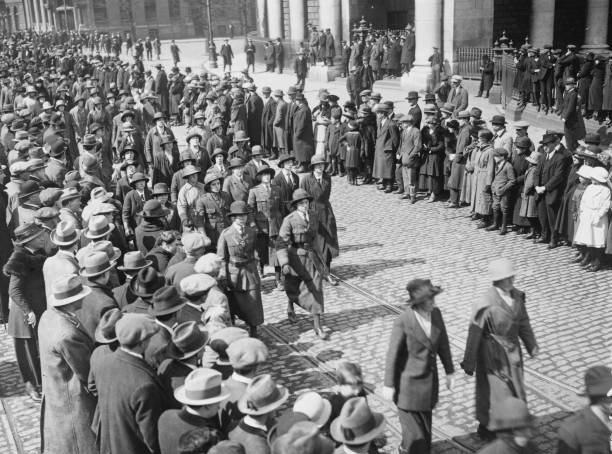
Cumann Na mBán marching in the funeral procession along College Green towards Sackville Street (O’Connell Street) 1922.
His inquest was attended by the Lord Mayor of Dublin.
Michael is interred in the Republican plot in Glasnevin, alongside Countess Markiewicz and many other notable figures. Inspired by Pearse’s oration, he had told his mother, Bridget, that he wished to be buried “at the feet of O’Donovan Rossa.”
Military Pension:
Paddy Rigney, a fellow Anti-treaty rebel, supported a claim for a military dependent’s pension by Sweeney’s mother and sister. A gratuity of £150 was recommended by the Army Pensions Board but rejected by the Dept. of Finance.