
Richmond Barracks
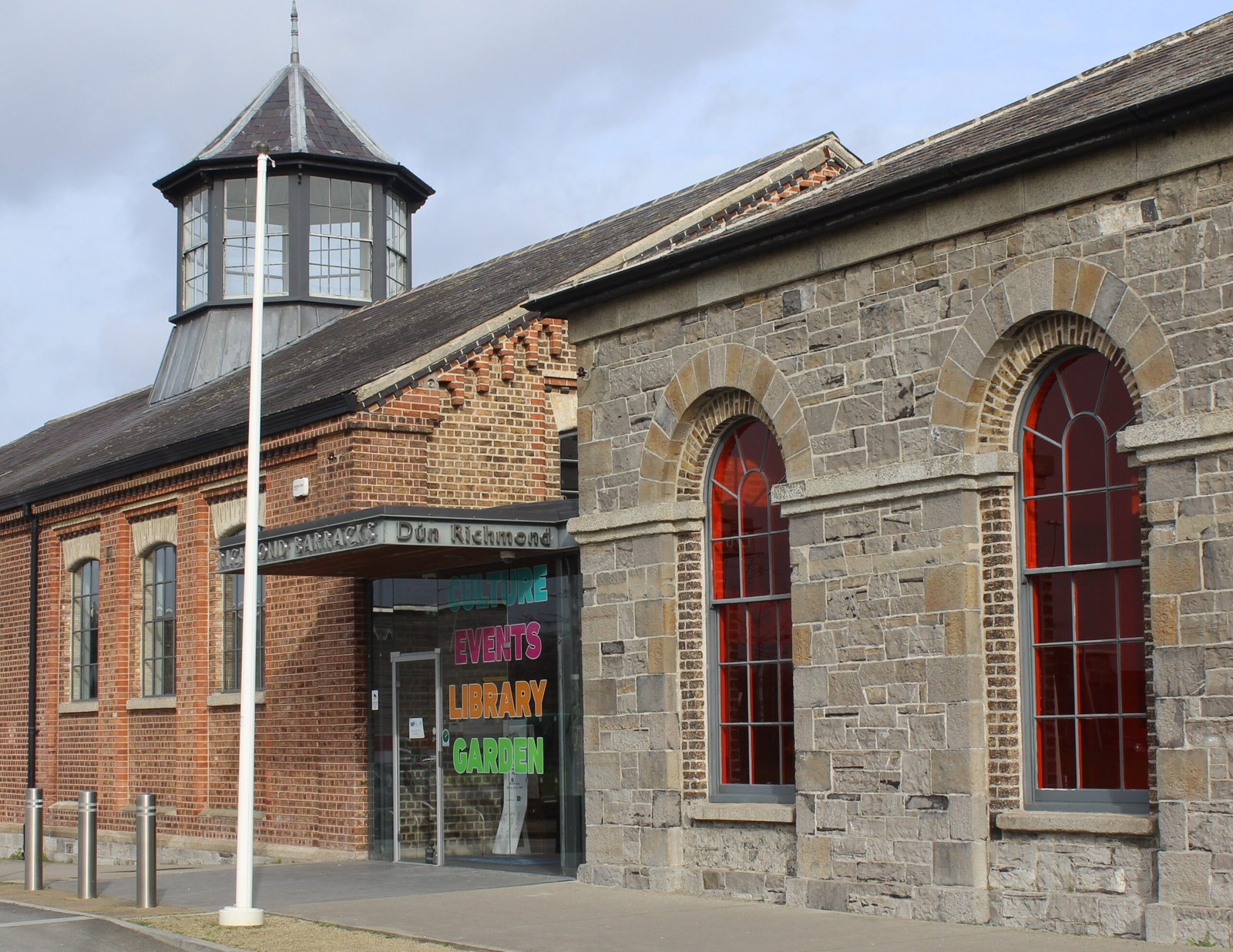
Built in 1810, Richmond Barracks was designed to house 1,700 troops. The built environment of military, industrial, and infrastructure shaped the local population. Richmond Barracks in Goldenbridge and the Artillery Barracks at Islandbridge between them accommodated more than 2,300 enlisted men, mostly single or unaccompanied on their tour of duty. Many of the engineers and the skilled workforce employed in local industry, and on the canals, railways and trams were recruited from British industrial cities.
Social Economy 1840’s
After the 1840s, the community that settled here were predominantly male, skilled working class, mostly unmarried with a significant cohort who were English and protestant. The religious mix introduced into the community led to occasional tensions between the churches over the cure of souls.
New Sewerage Channel
By 1887, a new sewage channel was constructed to discharge into the Camac, partially resolving the barracks’ sewage issues. However, the Town Commissioners prevented barracks from discharging the town’s effluent into the Camac.
The Women’s Reformatory
The Women’s Reformatory (1856-65) and the Girls’ Industrial School (1881-1983) The barracks were a magnet for the sex-trade. A red-light district developed in the Puck, the area west of Richmond Barracks. After 1855, the Sisters of Mercy settled in Goldenbridge House, and the next year founded a Women’s Reformatory. Women prisoners could ‘live-in’ for the last years of their sentence, to learn employable skills including sewing and laundering. The Goldenbridge Laundry remained open until the 1950s. In 1881, the Order replaced the Reformatory with an Industrial School – known as St. Vincent’s. The residential school was for girls and young women between the ages of 3 and 16 years, convicted of crimes, or who were thought to be at risk of ‘falling into’ criminality.’ It remained open until 1983. In the 1990s, Christine Buckley, a former pupil, brought the experiences of the children raised in St. Vincent’s Industrial School into national focus with the documentary Dear Daughter (Louis Lentin, 1996). The Goldenbridge Industrial School was one of those investigated by the Irish Commission to Inquire into Child Abuse.
New Kilmainham Ward
In 1900, the New Kilmainham Township was abolished. It was redesignated as the New Kilmainham Ward, and its operational area annexed by Dublin Corporation who spread the costs and benefits of improvements.
Fire At Mount Shannon Mill 1906
The Royal Berkshire Regiment stationed at Richmond Barracks in Goldenbridge North discovered the fire and sounded the bugle. The full regiment including Captains, Officers and troops attended the scene of the fire with two engines and tried to prevent it from spreading to the worker’s cottages.
The 1916 Irish Revolution
After the 1916 Rising it was the scene of the Military Trial of the Leaders of the Rebellion. Pearse, Connolly and other revolutionaries were transferred to Kilmainham Jail prior to their execution.
From Richmond Barracks to Keogh Square
On 14 th December 1922, Richmond Barracks (Goldenbridge North, the barracks at Island Bridge in the townland of Inchicore North and the Magazine Fort in the Phoenix Park were handed over to the Irish Free State.
Richmond Barracks was renamed Keogh Barracks, in honor of Tom Keogh, one of Michael Collins’s ‘Twelve Apostles.’ This property was part of a significant portfolio of state-owned assets nationwide that could be utilised to address the urgent national housing crisis.
To support urban local authority housing, new legislation was introduced in 1924 and 1925. By June 1924, the government announced plans to renovate Keogh Barracks and develop the adjacent land in Goldenbridge North. A team from the Board of Works was in place by August to supervise the refurbishment. In November of the same year, the government leased the Barracks to Dublin Corporation for use as public housing.
By late 1924, families began moving into the newly renovated apartments within the former barracks buildings. Each flat was equipped with its own internal toilet, a separate kitchen, and a spacious living area. The residents of these dwellings became known as ‘Barrackers.’
The Social Economy of Keogh Square
Though the residents of Keogh Square formed a close-knit and stable community, the refurbishment of Richmond Barracks proved to be an inadequate long-term housing solution, devolving into an urban tenement. The living conditions were substandard, lacking basic amenities such as electric lights, hot water, proper baths, and adequate fireplaces. The high ceilings made heating difficult, and dampness was a persistent issue. Exacerbated by the economic downturn of the 1930s, widespread unemployment and underemployment meant residents struggled to afford the high rents. This led to growing resentment over the poor quality of housing. From the 1930s to the 1960s, Keogh Square became synonymous with substandard social housing and severe deprivation.